October 19, 2026
Registering a Tree With the Live Oak Society: All Bark, No Bite
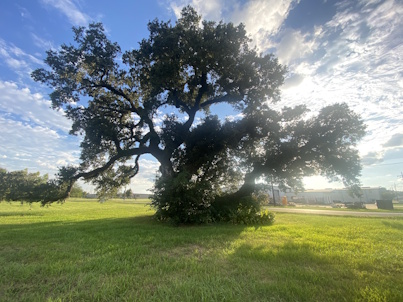
The Survivor Oak, a historic live oak near Scott, has survived before. Now the community is trying to save it again.
It’s easy to assume that registering a tree would be enough to legally protect it. Turns out, it’s not.
The Survivor Oak, located at 201 S. Bud St. near Scott, has been saved once before and now, bless its determined soul, needs to be saved again. This time, for good.
Originally, the tree was identified, championed, and subsequently registered with the Live Oak Society in 2007, thanks to the shared efforts of Trees Acadiana and an outpouring of support from the local community. In a time of polarity, division, and diverging values and perspectives, the one thing it seemed everyone and their mother could agree on was that this tree was worth saving.
Rebecca Begnaud, a prominent and involved member of the Scott community, was given the chance to name the oak and could intuit that Survivor would sum it up nicely.
The singular oak tree is a well-known landmark in Lafayette for its unique structure, longevity, and its apparent will to survive.
The famous tree was knocked over onto its side and uprooted by a powerful hurricane that swept through Lafayette in September of 1909. At 100 years old, it adapted to its bleak circumstances and somehow found a way to live.
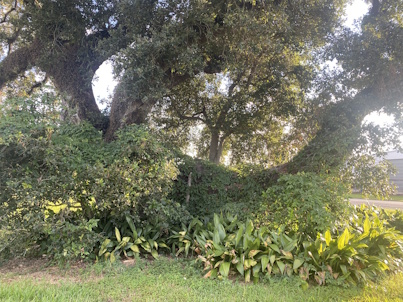
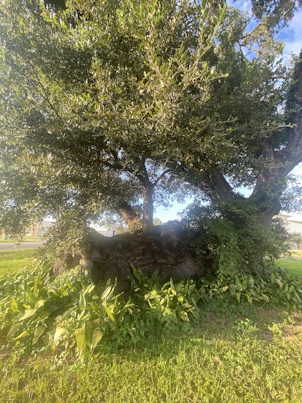
The trunk, now lying on its side, developed adventitious roots—roots that grow from unusual places. The horizontal trunk, exposed to water and soil, began to proliferate these adventitious roots, and they buried themselves into the soil, where they would go on to anchor the sideways tree deep into the earth once more.
The exposed roots, rather than drying up and withering away, began to bark over, creating a distinctive, gnarled extension of the original trunk. The branches, once growing horizontally, began reaching vertically toward the sun. New growth shot upward from the fallen trunk, creating the appearance of smaller oak trees growing from the side of the original.
The result is a rare and remarkable tree: an obvious ode to life, survival, and adaptation. Its story mirrors our own—a determined will to live and carry on.
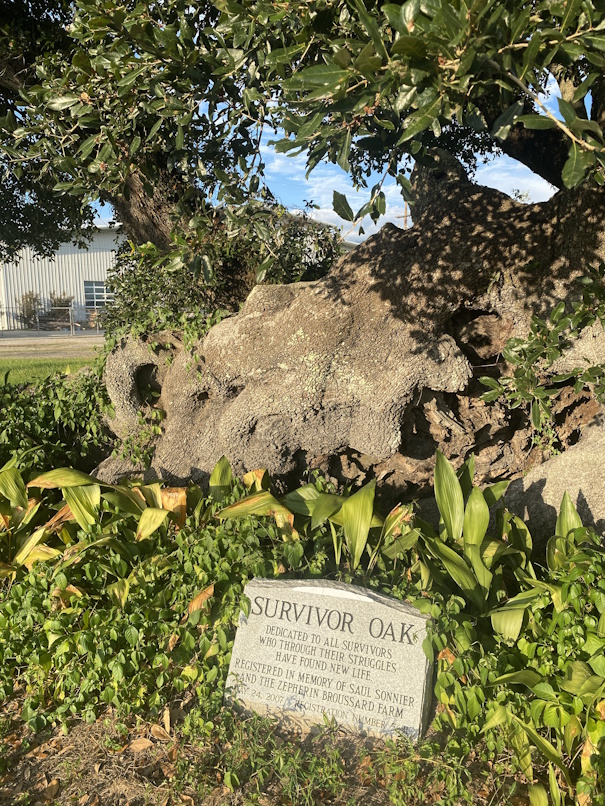
The plaque at the base of the Survivor Tree says as much:
Dedicated to all survivors, who through their struggles, have found new life.
A testament to the universal will to survive and the miracle of adaptation, shared not just by humans, but by all living things. The tree serves as an active thread, a gentle yet stubborn reminder that we are all connected in this tapestry of life.
Begnaud, attuned to this, can recognize the active life that pours from it. Not a passive entity, as we may often be fooled into thinking, but an incredibly alive one.
A visiting composer even declared himself to be so moved by the energy pouring from the tree that he described it as emanating a golden aura of light.
For the past twenty years, all of the individuals who championed the registering of the Survivor Oak have been able to move on, resting soundly, knowing this remarkable and historic tree was safe.
Imagine Begnaud’s surprise, perhaps an understatement, when she saw the “For Sale” sign on the plot of land where it stands. 3.49 acres for sale to an industrial development buyer.
Because the Survivor Tree lives on a private lot of land, it will be entirely at the mercy of the private property owner. If and when a developer purchases it, they legally have the right to clear it.
According to Motovo.com, where the property is listed, the sale includes a registered Live Oak, the Survivor Tree, on the property. One can only hope that potential buyers consider this to be an asset rather than a nuisance.
After speaking with Begnaud about the current conundrum and how to best ensure this historic tree will be protected, it’s clear that Begnaud accepts that the future will be what it is.
Whether or not the tree continues to live or is lost to development, she knows there are things beyond her control. But, she says, there are things we can do in the meantime.
Begnaud believes the tree’s symbolism belongs to all of us. Its story speaks to the incredibly human themes of resilience, survival, hope, and finding new life after circumstances have fundamentally changed. And, she argues, this has been all of us at one point or another.
Her goal now is to raise awareness, rally the community together once again, and unite our voices to speak for this tree, which stands for all of us, and yet is unable to speak for itself.
The Survivor Tree has survived before. Now, Begnaud is trying to save it again. And lord willing, let it be the last.